01 · Investor & Catalyst Briefing · Preclinical Stage
A low-dose psilocybin capsule, designed to be taken at home
Xycota is developing a low-dose oral treatment intended for use at home. If clinical studies establish safety and benefit, this approach could reduce the practical burden of prolonged supervised psychedelic sessions.
On October 29, 2026, BioAdaptives, Inc. and Xycota Biosciences, LLC entered into a definitive acquisition agreement, reported on SEC Form 8-K filed November 4, 2026 (subject to customary closing conditions).
A two-minute overview of the 2026 rat TrkB finding, the repeated-dose blinding question, and the planned 28-day mild PTSD study.
02 · Delivery Model Comparison · Proposed Preclinical Design Goal
A different treatment model, if the science translates.
Comparing supervised clinic administration with Xycota’s proposed outpatient design goal. Xycota’s candidates are preclinical; clinical safety, blinding, and efficacy in humans have not yet been established.
Supervised Psychedelic Treatment
- Setting Clinic setting
- Time Commitment Scheduled multi-hour attendance
- Perceptual Profile Prolonged supervised psychedelic dosing
Xycota’s Proposed Approach
- Formulation Standardized oral capsule
- Intended Setting Intended at-home outpatient use
- Dosing Design Goal Sub-perceptual dose designed to avoid noticeable psychedelic effects
03 · Investigational Pipeline · All Programs Preclinical
Two preclinical programs targeting synaptic repair
| Program & Candidate | Indication & Delivery | Current Stage (Preclinical) | Next Decision Gate |
|---|---|---|---|
| XYCO-02 Lead Asset |
Mild PTSD Sub-perceptual oral psilocybin capsule |
Preclinical cGMP & CTA dossier with KGK Science |
Canadian CTA & Phase 1 PK/PD waiver submission |
| XYCO-01 Follow-On |
Frontotemporal Dementia (FTD) Neural-exosome psilocin |
Preclinical FDA Orphan Drug Designation filed |
FDA ODD feedback & gated head-to-head FTD animal study |
+ What “sub-perceptual” means & clinical dosing design goal
What “sub-perceptual” means: Sub-perceptual describes the preclinical design goal for XYCO-02: low-dose oral psilocybin formulated to remain below the threshold of noticeable psychedelic effects (with a 1.5 mg reference dose evaluated in planning and final clinical dose to be determined). Whether participants with mild PTSD can distinguish XYCO-02 from placebo during repeated 28-day dosing remains an open clinical question.
04 · Published Preclinical Evidence · Observed in Rats
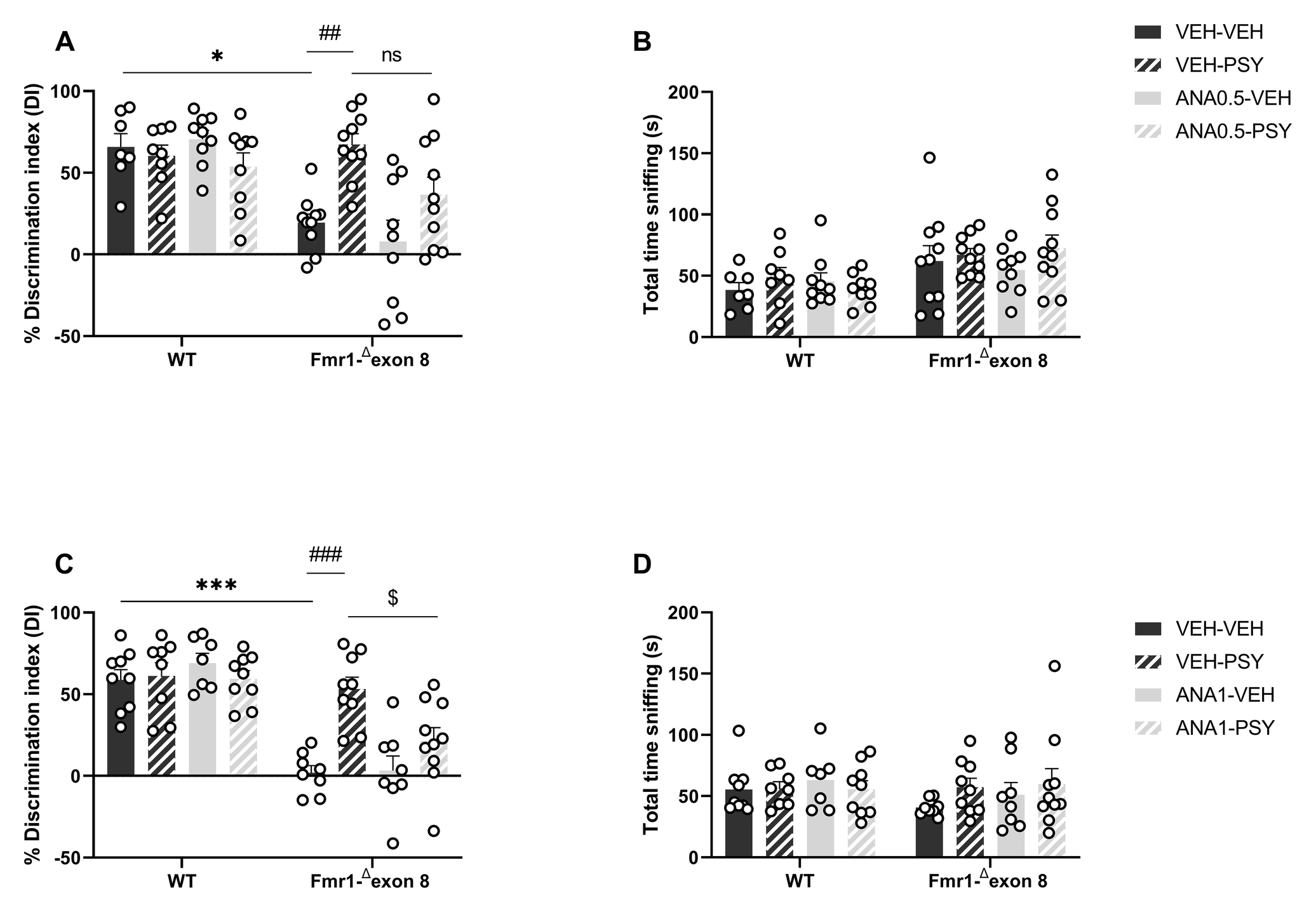
Cognitive rescue in a Fragile X rat model required TrkB signaling, not 5-HT2A activation
Published in Neuropsychopharmacology (July 2026) and co-authored by Xycota CSO Dr. Marvin S. Hausman, MD in Fmr1-Δexon 8 rats.
TrkB required; 5-HT2A blockade did not prevent rescue
Repeated low-dose oral psilocybin restored object-recognition memory and normalized prefrontal cortex mature BDNF/TrkB/pAKT; blocking TrkB (ANA-12) abolished the rescue, while blocking 5-HT2A or 5-HT1A did not.
Not yet demonstrated in humans or in PTSD
The 2026 study evaluated a genetic rat model of Fragile X Syndrome, not a trauma model or human subjects.
+ Explore the evidence & published figures (Fig. 3 & Fig. 5)
BDNF/TrkB signaling hypothesis: These preclinical findings suggest synaptic repair signaling in rats can proceed through BDNF/TrkB rather than the 5-HT2A receptor associated with acute psychedelic effects.
05 · Decision Timeline & Falsification Criteria
What happens next
Solid bars denote active company preparation; dashed bars denote conditional regulatory review and clinical execution.
cGMP Capsule Dossier
Finalize cGMP capsule stability package for XYCO-02 clinical supply with CRO partner KGK Science.
Canadian CTA Filing
Submit the XYCO-02 Clinical Trial Application and Phase 1 PK/PD waiver request with KGK Science.
Health Canada & REB
Health Canada and Research Ethics Board evaluate CTA authorization and Phase 1 PK/PD waiver request.
28-Day Mild PTSD Study
Run 28-day double-blind outpatient study (CAPS-5 + blood BDNF) following regulatory clearance.
+ Proposed 28-day mild PTSD study mechanics (KGK Science, CAPS-5 primary endpoint & supporting blood BDNF readout)
Outpatient trial architecture: Proposed randomized, double-blind, placebo-controlled 28-day at-home regimen of a standardized, sub-perceptual oral psilocybin capsule vs. matched placebo in adults with mild PTSD, conducted with CRO partner KGK Science.
Endpoints: Clinician-Administered PTSD Scale for DSM-5 (CAPS-5) serves as the primary clinical endpoint, paired with serum BDNF in blood as a supporting pharmacodynamic readout (not a surrogate endpoint). Specific sample size, statistical powering, and secondary endpoint hierarchies remain subject to science-team sign-off and Health Canada CTA review.
+ Regulatory precedent, prior NCT05832255 context & financing dependencies
Prior KGK Science & Health Canada context: CRO partner KGK Science previously conducted a Health Canada authorized study of low-dose, sub-perceptual oral psilocybin in adults with Fragile X Syndrome (NCT05832255), sponsored by Nova Mentis Life Science Corp., where Xycota CSO Dr. Marvin S. Hausman, MD previously served as Scientific Director (Nova Mentis has since undergone corporate restructuring and ceased its research operations). That study was open-label, single-arm, enrolled up to 10 participants, and is listed as suspended pending protocol revisions. Xycota does not own or control that dataset.
Material dependencies: Whether prior cGMP low-dose capsule experience and Health Canada outpatient authorization precedent support a Phase 1 PK/PD waiver for XYCO-02 is a decision for Health Canada; no regulatory decision date is promised. Study initiation is conditional on CTA authorization, REB approval, cGMP supply release, and financing close.
Three questions the study must answer
Principal unresolved questions & falsification criteriaDoes a Fragile X rat mechanism translate to human PTSD?
Direct answer: Not yet demonstrated; our 2026 study evaluated object recognition in a genetic rat model of Fragile X Syndrome, and we have not run a rodent fear-extinction or trauma study.
+ Read full scientific context & resolution gate
PTSD involves distinct neural circuitry from Fragile X Syndrome. Our hypothesis that BDNF/TrkB synaptic restoration is indication-agnostic draws on published literature (Peters et al., Science 2010; Moliner et al., 2023), but remains untested in human trauma. Resolution requires CAPS-5 symptom separation from placebo in the planned XYCO-02 study.
Does blinding hold with sub-perceptual dosing over 28 days?
Direct answer: Open clinical question; single-dose healthy-volunteer threshold data (Levy-Cooperman et al., 2026) do not establish whether mild PTSD patients remain blinded over 28 days of repeated at-home dosing.
+ Read full scientific context & resolution gate
In macrodose psychedelic trials, functional unblinding exceeds 90% (Muthukumaraswamy et al., 2021). XYCO-02 is formulated to stay below perceptual thresholds, and the planned 28-day outpatient study will prospectively measure blinding integrity alongside CAPS-5 outcomes.
Does peripheral blood BDNF reflect central brain repair?
Direct answer: Serum BDNF is a noisy peripheral measure subject to platelet and assay variability; it is a supporting pharmacodynamic readout, not a surrogate endpoint.
+ Read full scientific context & resolution gate
A change in peripheral blood BDNF alone does not establish central synaptic repair. Researchers plan to evaluate blood BDNF strictly alongside primary CAPS-5 clinical scores under standardized collection and pre-specified assay controls.
06 · Responsibility & Governance
Who will execute
Dr. Marvin S. Hausman, MD
Chief Scientific Officer & Co-Founder · Xycota Biosciences
Co-authored the 2026 rat study; former NIH USPHS Surgeon and developer of six FDA-approved NDAs. Full biography →

Brad Listermann
Co-Founder & CEO · Xycota Biosciences
Directs strategy, IP, and capital formation; inventor with filed patent applications spanning AI and cryptographic systems. Full biography →
Lt. Col. Elton Johnson Jr. (Ret.)
Incoming Board Director / Advisor · Founder, AmeriVet Securities
Provides institutional broker-dealer regulatory governance (FINRA Series 24/27/7/53) and 37-year combat veteran oversight. Full biography →
Associate Professor Viviana Trezza, PhD
Associate Professor of Pharmacology · Roma Tre University (Italy)
Senior author who led the behavioral pharmacology experiments establishing TrkB-dependent rescue in the 2026 rat study. Full biography →

Dr. Louise Hecker, PhD
Scientific Collaborator · Baylor College of Medicine
Senior author of the 2025 npj Aging study on psilocin and cellular survival in aged mice. Full biography →

Andrew Charrette, MSc
Director of Regulatory Affairs · KGK Science Inc. (Canada)
Advises on Xycota’s Health Canada Clinical Trial Application (CTA) and Phase 1 PK/PD waiver submission. Full biography →
07 · Public Filings & Confidential Diligence
Investor resources and diligence access
Immediate access to public SEC filings and peer-reviewed publications on the left, or NDA-gated institutional data room access on the right.
Public Investor Resources & Filings
Brad Listermann, Co-Founder & CEO
Confidential Institutional Data Room
Qualified institutional investors and strategic partners may request access to confidential CMC, Health Canada CTA, and FDA Orphan Drug dossiers following mutual NDA execution.